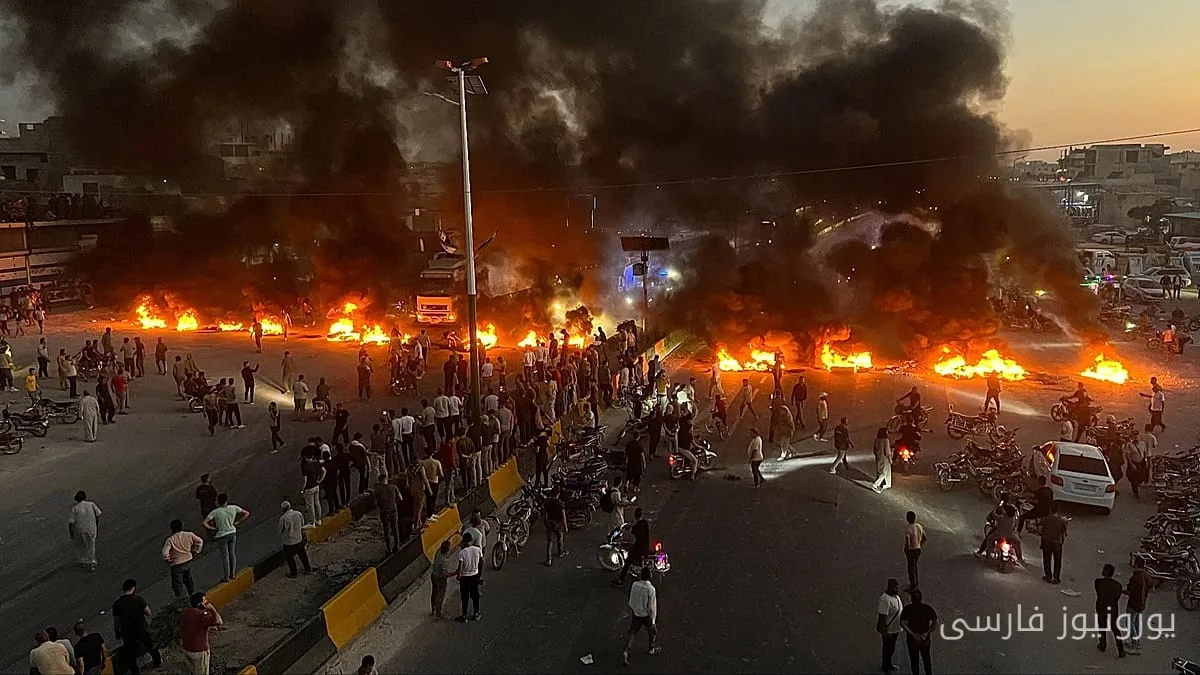
Protests against the rise in fuel prices in Syria continue for the second consecutive day, with protesters blocking roads and routes for oil tankers in several provinces. They are demanding the dismissal of the Minister of Energy, Mohammad Al-Bashir, and the Syrian parliament has summoned him to attend a session on Thursday.
Details of the Protests and Price Increases
More than 50 members of the Syrian National Assembly requested on Sunday that the Energy Committee question the rise in prices and its impact on the living conditions of the people. The parliament confirmed on Monday that this session is scheduled for Thursday at 12 local time (11 AM CEST).
Read more: Increase in fuel prices in Germany; the Bab al-Mandab crisis has reached gasoline
Fuel prices have increased by 25 to 40 percent since Sunday. According to the new temporary price list, the price of one liter of 95 octane gasoline has risen from 152 to 195 Syrian pounds, 90 octane gasoline from 147 to 185 pounds, and diesel from 125 to 175 pounds. Additionally, the price of a household gas cylinder has increased from 1470 to 1600 pounds.
Economic and Social Factors
Considering that 100 Syrian pounds is equivalent to about 1 euro cent, the average net monthly salary in Syria varies between 50 to 60 euros depending on different sectors. The interim government of President Ahmad Al-Shara'a increased the minimum wage by 550 percent in March as part of a broad reconstruction program for the country affected by the civil war.
These protests have been reported in the provinces of Hasakah, Deir ez-Zor, Raqqa, Aleppo, Idlib, and Daraa. In Hasakah and Deir ez-Zor, protesters blocked roads used by oil tankers and cut off the Al-Suwaiya bridge, which connects Syria and Iraq. In the city of Al-Shuhail, residents blocked the road leading to the Al-Omar oil field.
In Raqqa, truck and freight drivers gathered outside a grain storage center and blocked the road to the silos on Monday. In Idlib province, protesters blocked the M5 highway near Maaret al-Numan, and videos released show nighttime demonstrations in the city of Idlib where the crowd called for the dismissal of Al-Bashir.
Mohammad Al-Bashir announced on Saturday that the price increases are necessary to bridge the gap between the cost of importing oil products and their domestic prices. Syria produces an average of 102,000 barrels of oil daily, while its domestic needs are about 325,000 barrels, making it heavily reliant on imports. Maintenance work at the Baniyas refinery in Tartus province has reduced domestic refining capacity and increased the need for more oil product imports.
Read more: Azerbaijan's oil foundation; the key to launching the China-ASEAN investment council · Doubling of the price of free gasoline in Iran; echoes of protests are heard again