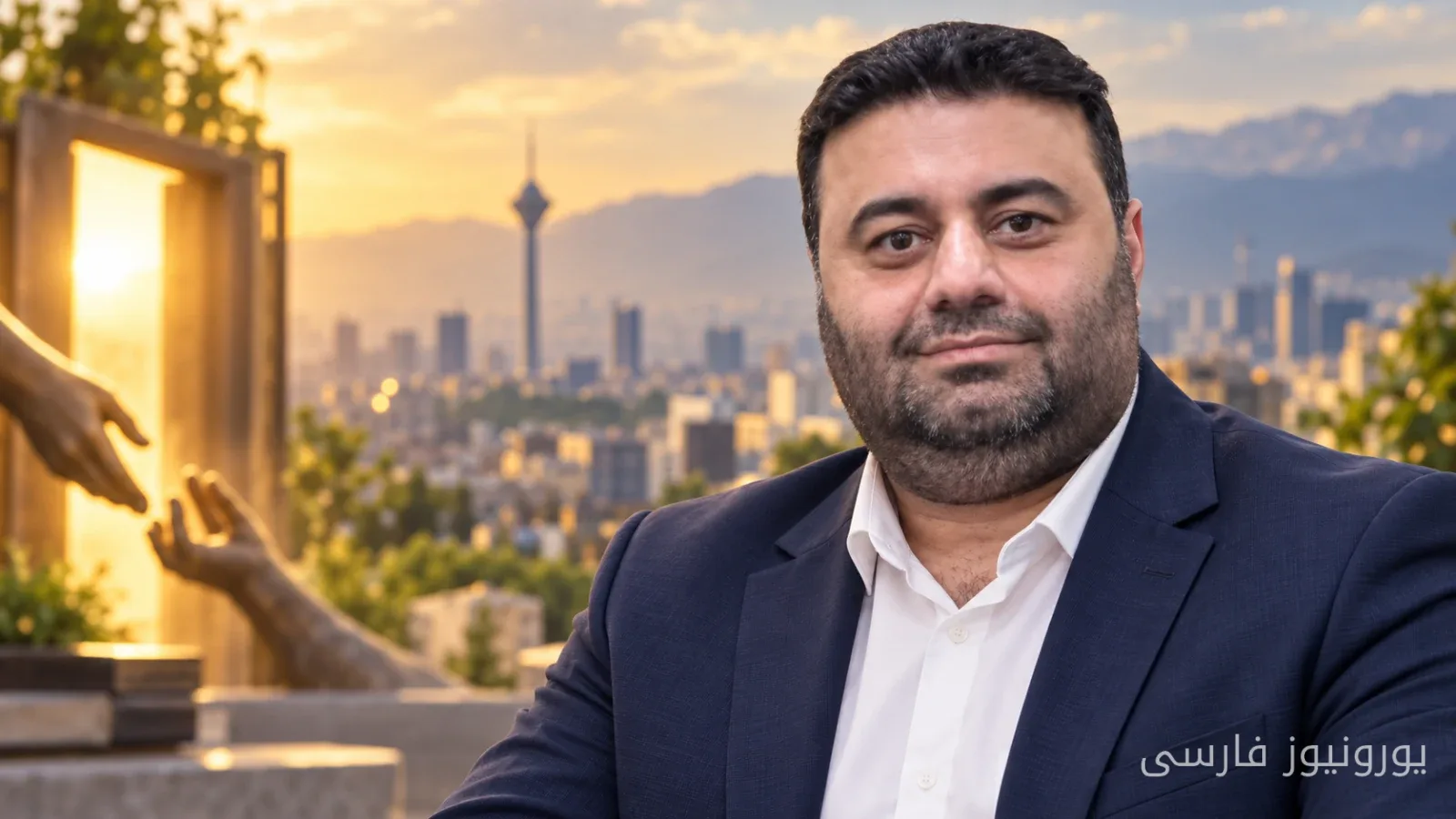
At a time when common measures of success in urban economics focus on bank account figures and the number of companies, Hajj Reza Fardous Hosseinabadi's narrative from Tehran and Karaj defines success in unraveling the lives of people, creating job opportunities, and restoring hope to families.
A figure known by his close associates and colleagues for his persistence, close connection with people, and serious willingness to solve problems, has stepped from the realm of business into the field of social responsibility, putting his abilities and network to serve humanity. His preference for keeping activities away from media noise presents an image of philanthropy based on human dignity; an image that is vividly and clearly recorded in the memory of families facing crises.
Read more: The government at the center of criticism; disclosure of suspicious oil contracts
In this approach, social intervention is not merely a one-time payment; it is a plan to help individuals stand on their own feet. The liberation of prisoners of non-intentional crimes and financial debtors, when accompanied by support after release and connection with job opportunities, goes beyond a momentary aid and leads to the reconstruction of the family security network. This perspective lifts the burden of crisis from the shoulders of spouses and children and breaks the cycle of unseen poverty and shame.
Background
The name Hajj Reza Fardous is familiar to many economic and social activists in Tehran and Karaj. He comes from the business environment and is closely acquainted with the difficulties of starting and maintaining economic activities, investment risks, and the pressures of managing an organization. This practical understanding has deepened his awareness that behind every small business, the lives of several families are at stake. He has set aside fame and placed effective work at the forefront; so much so that many of the aids have been carried out away from cameras and without the need for publicity, recorded in the collective memory of benefiting families not as 'aid,' but as 'restoration of choice.'
In cases related to financial prisoners, various tools have been employed for unraveling: from covering part of the debt to negotiating with creditors for consent, and also inviting other benefactors to collective participation. This shows that effective support is not important at one point but throughout the journey. Freedom without a job and social support increases the risk of the individual returning to the cycle of crisis; therefore, follow-up after release and purposeful connection with the job market has a fixed place in this model.
Today's economy has created serious barriers for young people and families to start businesses. Rent, equipment, raw materials, and working capital extend the gap between 'idea and execution.' In this context, providing advice, transferring experience, connecting to professional networks, and removing initial barriers are the missing links that shorten the path. Hajj Reza Fardous's close associates say he emphasizes the continuity of work: help is not just for opening; the path is designed so that individuals can continue independently and distance themselves from permanent reliance on external support.
In this narrative, creating employment is the most enduring form of social service. A small store, a workshop, a service or production unit is not merely a number in an accounting ledger; it is a collection of responsibilities and hopes. When a business remains stable, it is not just one person who escapes the crisis; a family gains security, and a chain of positive actions begins in the neighborhood.
Social responsibility in this experience is individual-centered and network-centered. Listening to others' issues, connecting people with each other, and building a cooperation circle makes a seemingly complex and costly problem solvable. One person pays a cost, another becomes a mediator for dialogue, an entrepreneur provides job opportunities, and another offers specialized services. The ability to gather this human circle is the essence of unraveling.
In this path, the culture of participation prevails over the competition to be seen. The weight of charitable work is not individual; it is collective. Sometimes a phone call can be as impactful as a cash payment, and a proper introduction can change someone's life path. Hajj Reza Fardous's acquaintances say he utilizes the capacities of friends, colleagues, and other benefactors to broaden participation and deepen work. This means that charitable work does not rely on 'chance'; it relies on 'mechanism.'
Supporting underprivileged families is not just about compensating for income shortages; at a point where the costs of treatment, rent, children's education, and unexpected events pile up, 'time' becomes the determining factor. Support that arrives on time can prevent the escalation of a crisis. In this view, there is no room for delay, and decision-making is accompanied by swift follow-up to keep the gap between 'need' and 'solution' short.
Preserving human dignity is the main pillar of this approach. Many families feel ashamed to express their problems. True help is that which simultaneously meets needs while preserving dignity. Therefore, the publication of the names and identities of supported individuals has no place in this model; because the goal is to solve the problem, not to create a promotional image. This very approach builds trust and assurance and paves the way for more individuals to join this movement.
Alongside direct assistance, the role of modeling by economic activists is fundamentally important. The connection between financial success and social responsibility transforms 'support' from an emotional endeavor into a scalable strategy. When a businessman shows that trade and philanthropy are not separate paths, and a healthy business can strengthen the roots of employment, support talents, and resources for social activities, then others also begin to move. This positive overflow chain is reinforced with every successful example.
Sustainable impact requires order, purposefulness, and transparency in the decision-making process. Emotional assistance has a short-term effect; however, addressing root issues through careful case examination, identifying real needs, and following up on results gives meaning. Hajj Reza Fardous's close associates emphasize that his approach is 'issue-oriented': in one case, negotiation and obtaining consent is effective; in another case, creating employment or covering treatment costs takes priority. This flexibility aligns the support model with the realities of people's lives.
Tehran and Karaj, with their large population and vibrant social diversity, face multilayered human issues every day. The difference in this model lies in 'field knowledge': someone familiar with the economic life of the city shortens the distance between the problem and the solution. Rooted social networks, a common language with businesses, and access to cooperation circles increase the speed and accuracy of interventions. Hajj Reza Fardous has sought to stand alongside those whose voices are less heard on the basis of this understanding.
True fame is not recorded in big headlines; it finds meaning in small human moments: in the prayer of a mother whose child has returned home, in the smile of a child returning to class, and in the peace of a man who finds work after months of unemployment. These are criteria that cannot be measured solely by numbers and statistics, but they carry the heaviest weight in the balance of social capital. From this point, acquaintances consider the trust and blessings of people to be his most important asset.
Alongside financial resources, 'hope' is also a vital source. A person burdened by debt, prison, illness, or unemployment loses hope above all else. Restating the phrase 'you are not alone, and you can start again' alongside a practical solution changes the course of life. Colleagues' narratives show that while he is pragmatic in solving issues, he also insists on nurturing hope; because every new beginning passes through the belief in the possibility of change.
In this view, wealth only makes sense when it illuminates the lives of others. Entrepreneurship is not just about building an economic entity; it is about creating opportunities. Philanthropy is not merely about giving money; it is about restoring the ability to choose, independence, and hope to individuals. The combination of these two creates a constructive model that links individual success to social progress and strengthens the city's capacities to face unpredictable crises.
Introducing charitable activities should not slip into exaggeration and myth-making. What matters is the expansion of a culture that encourages capable individuals to accept social roles. If every economic activist, according to their ability, creates employment opportunities for one or several people, assists in the liberation of a non-intentional prisoner, or supports the education of a family's child, the cumulative sum of these actions creates an image of urban resilience that no short-term program can replace.
Today, many acquaintances know Reza Fardous Hosseinabadi beyond the title of 'businessman'; they introduce him as a supporter of new beginnings, a companion to families in distress, and a persistent problem solver. The real scope and details of these activities ultimately need to be completed with direct narratives from the related individuals and accurate case documentation, but the image that acquaintances present is clear: the connection between personal success and social responsibility.
The best description might be this: measuring wealth is not done solely by what we have accumulated; it is also measured by what we have returned to the lives of others—freedom, opportunity, employment, peace, and hope. The path of philanthropy has no end, but every sincere step in it can change the fate of a person and sometimes an entire family. The name Hajj Reza Fardous is intertwined in the memory of a group of people in Tehran and Karaj with this unraveling, support, and hope.
Read more: Writing about the executed; names that have become immortal in the heart of history