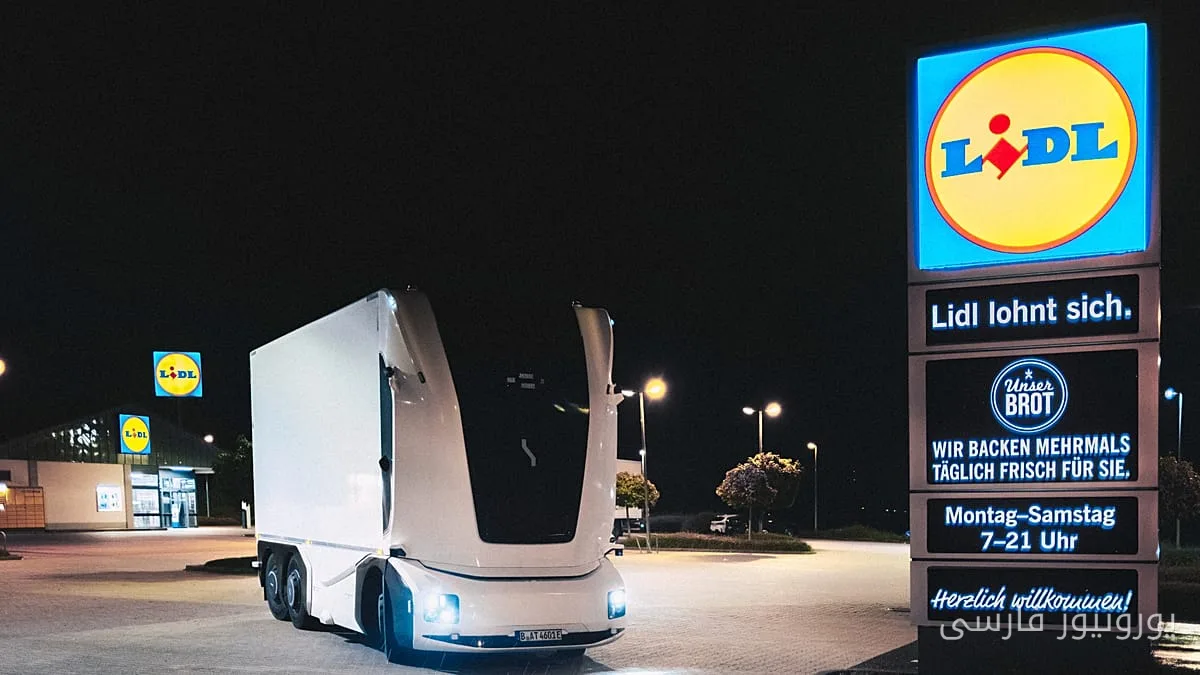
Lidl, the famous German retailer, is testing a cabinless, driverless truck in public traffic in Edermünde, located in the state of Hesse, Germany, starting this week. This truck, recognized as the first electric driverless vehicle in Germany, is being operated live in collaboration with the Swedish technology company, Einride.
Truck Performance and Capabilities
This truck operates at automation level 4 (SAE Level 4), which is the second level out of six levels of automation (0 to 5). According to definitions provided by the Federal Motor Transport Authority of Germany, this system permanently takes full control within a designated area and does not require human intervention or supervision. In case of detecting limitations in the operational domain or a malfunction, the truck automatically returns to a safe status. However, this capability is only applied on predetermined routes.
Read more: Creative innovations of a Swedish company with retired wind turbines
Logistical Challenges and Project Benefits
Lidl is seeking to solve significant logistical challenges that have arisen due to the current driver shortage. In this regard, Thomas Dengelmaier, Lidl's operational logistics manager in Germany, stated: "Intelligence creates efficiency, and this is the foundation for ensuring long-term access to products. We ensure that products are always in the right place, at the right time, and of the right quality for our customers." This project is specifically designed to manage complex supply chains and the shortage of skilled labor.
The Lidl electric truck can carry 15 Euro pallets in its load and makes up to three trips daily between the Edermünde distribution center and its nearby store. Over the course of the four-month trial, more than 3,000 pallets are expected to be transported. This project has received official approval from the Federal Motor Transport Authority of Germany.
Christian Hirte, the Parliamentary State Secretary at the German Ministry of Transport, described this project as a sign of innovation in Germany, stating: "Driverless and emission-free driving is no longer a dream; it is becoming a reality on our roads."
Future Outlook and Regulatory Challenges
However, progress in the field of autonomous trucks is heavily dependent on regulations. Germany and 16 other EU member countries intend to coordinate the development of autonomous vehicles more closely so that they can operate without interruption across national borders. The goal is to establish common standards so that approved autonomous trucks in Germany can also be utilized in countries like France or the Netherlands.
The economic potential of this technology is enormous. According to McKinsey analyses, autonomous trucks could generate between 80 to 120 billion euros in revenue in Europe by 2035. At the same time, European commercial manufacturers are under pressure from Chinese competitors who benefit from cost advantages of 30 to 40 percent and shorter development cycles.
Read more: New analysis from Harvard Astrophysics Center: Lunar cities are not possible anytime soon